TLDR; Mining, oil & gas, and other energy organisations have traditionally used automation to predict and optimise equipment maintenance. AI presents an opportunity to take this a step further, with an intelligent system recommending and coordinating maintenance response for improved safety, reliability and cost efficiency in operations.
Data shows that equipment failure causes 42 percent of unplanned downtime, draining $50 billion annually across mining, oil & gas, energy, and related sectors. Mining operations face some of the steepest losses due to heavy, interconnected equipment.
So far, maintenance strategies have evolved from reactive repairs to scheduled preventive maintenance and, increasingly, predictive maintenance. Each approach addresses some limitations of the last but also involves trade-offs.
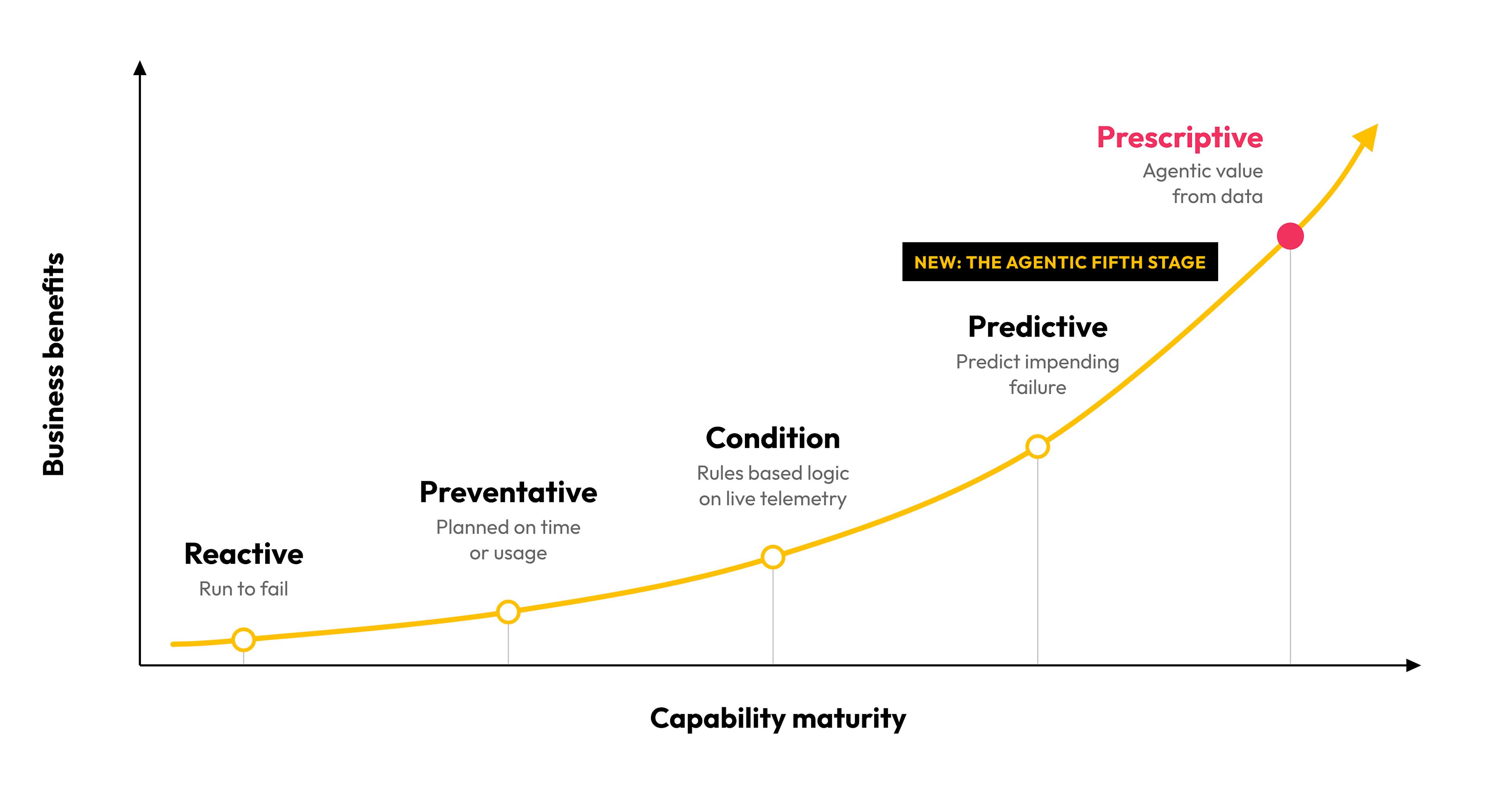
Reactive approaches prioritise equipment utilisation, allowing assets to run until they fail. While appropriate for some low-criticality assets, it exposes critical operations to significant safety and financial risks. Even 1% unplanned downtime, or 3.65 days, costs organisations upwards of $5 million every year.
Preventive maintenance services equipment at scheduled intervals to reduce failure risk. However, fixed schedules do not account for actual condition. Maintenance costs escalate without necessarily improving reliability.
Predictive maintenance (PdM) addresses some of these limitations. Rather than relying solely on fixed schedules, maintenance teams use equipment data to identify patterns and intervene only when an asset shows signs of deterioration. However, predicting a failure does not automatically determine the safest, most cost-effective time to intervene.
From Predicting Failure to Prescribing Action
To determine when and how to intervene optimally, engineers need to assess several factors like:
Severity and likelihood of failure
Operational impact
Competing maintenance requirements
Availability of maintenance resources
In complex mining and energy operations, it also involves coordinating equipment availability, maintenance crews, spare parts and production schedules across multiple interconnected assets.
This is where predictive maintenance reaches its limits. The next step is to move beyond identifying what might fail towards determining what should happen next.
The Business Value of Prescriptive Maintenance
AI presents an opportunity to advance towards this next stage of maintenance maturity, resulting in measurable business outcomes like:
Improved operational safety - Automated workflows can ensure that appropriate checks and approvals are completed before maintenance actions proceed.
Increased equipment availability and production - AI agents plan interventions around operational requirements while reducing unnecessary servicing.
Reduced total cost of maintenance - Targeted maintenance helps organisations plan inventory and engineering resources while reducing emergency call-outs and secondary failure.
A Practical Example: Smarter Maintenance for Mine Lifts
To demonstrate how this works in practice, let's consider a fleet of lifts operating at a mine site. Each lift generates continuous streams of operational data, such as motor temperature, shaft vibration, current draw, cab speed, door cycles, and trip events.
We need a prescriptive maintenance system that can analyse this data and take optimal maintenance actions.
Challenge 1: Finding the Signal in the Noise
Continuously analysing high-volume sensor data can be expensive, especially when most readings don't require intervention. Limited connectivity and air-gapped networks also make cloud-dependent analysis impractical.
Solution: Detect and triage anomalies locally.
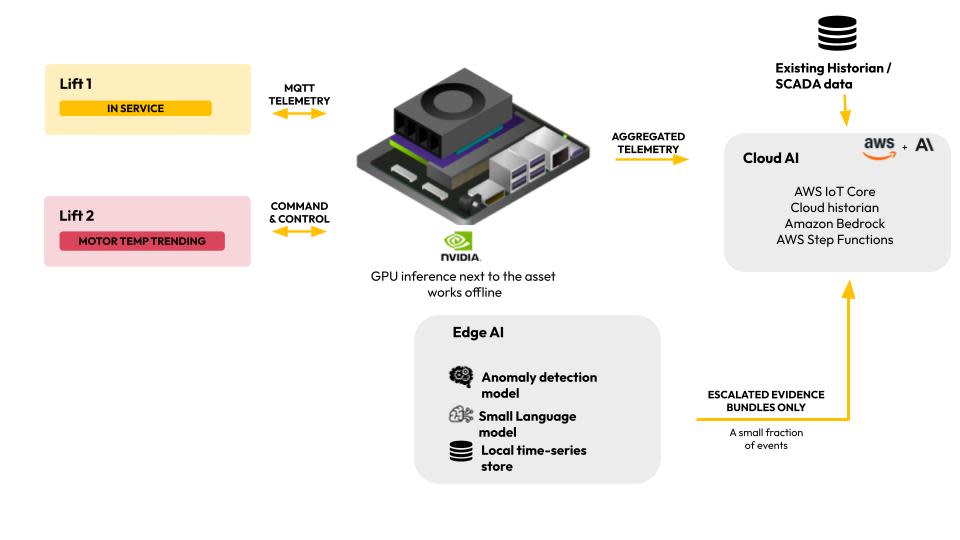
Bring compute and intelligence closer to the equipment. The system can identify unusual behaviour locally and escalate to the cloud only where additional analysis is needed.
In our example architecture, an NVIDIA Jetson Orin Nano serves as the edge device. It runs two models.
An anomaly detection model that scores sensor readings locally, identifying deviations from established operating patterns. For example, if a motor begins drawing more current because a bearing is starting to fail, the model can detect the change in near real time.
A small language model (SLM) that acts as a local triage engineer. It translates numerical alerts into plain-language events that are easier to interpret.
Instead of presenting an isolated temperature reading, the SLM might report: Motor temperature on Lift 2 has risen 3.1°C over the last six hours, with no corresponding change in duty cycle.
In practice, the anomaly detection model could be any existing model within your predictive AI system. The SLM could be Microsoft's Phi-3 quantised to fit within available memory.
Challenge 2: From Anomaly Detection to Maintenance Recommendations
To make a useful maintenance recommendation, the system needs to consider a detected anomaly in the context of the asset's history and previous interventions. At enterprise scale, deeper intelligence is hidden across similar failures in multiple mine sites and the service history of hundreds or thousands of such elevators the organisation may be operating.
The SLM is fast, works offline and keeps raw telemetry local. However, its context window and local resources limit its ability to reason across a fleet of thousands of assets. It cannot retrieve enterprise maintenance records and compare long-term trends.
Solution: Combine local detection with cloud-based reasoning.
For these more complex tasks, we use Claude Opus through Amazon Bedrock.
For example, consider a scenario where Lift 2 motor temperature is rising by 0.4°C per day over 18 days, while Lift 1 remains stable. The edge system escalates the anomaly. The cloud model
Retrieves the last 90 days of Historian data for the affected asset and comparable assets.
Retrieves previous work orders from the computerised maintenance management system (CMMS), including technician notes
Consults the relevant section of the original equipment manufacturer's (OEM) maintenance manual.
The model determines that the last service on Lift 2 replaced the brake but did not inspect the motor bearings. The same pattern preceded bearing failures on 11 lifts over the previous two years.
It recommends a bearing inspection within 14 days and provides evidence and confidence levels supporting the recommendation.
Challenge 3: From Recommendation to Coordinated Action
Automated recommendations do not guarantee that maintenance happens at the right time. If activities such as ordering parts, scheduling, and approvals remain entirely manual, the organisation still faces delays between identifying a potential failure and acting on it.
Solution: Orchestrate the maintenance workflow.
We recommend using a cloud service like AWS Step Functions to coordinate the activities that follow an AI-generated recommendation. It can receive the Claude recommendation and supporting information, then follow a workflow, i.e. a series of steps and transitions based on the detected issue and diagnosis confidence.
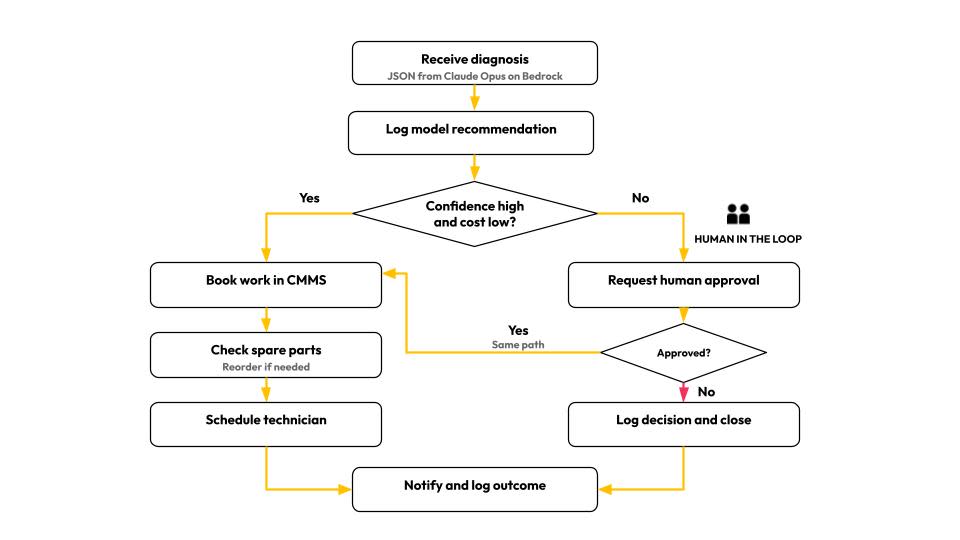
Depending on the situation, the workflow can:
Request approval from a maintenance supervisor.
Check spare parts availability.
Schedule a technician for an appropriate maintenance window.
Create a work order in the ERP or maintenance management system.
Record the status of each step and the decisions made along the way.
Challenge 4: Ongoing Improvement After Every Maintenance Intervention
Maintenance intelligence should improve as more evidence becomes available. Otherwise, the organisation risks prescriptive recommendations that do not reflect actual maintenance outcomes.
Solution: Close the loop between maintenance and operational data.
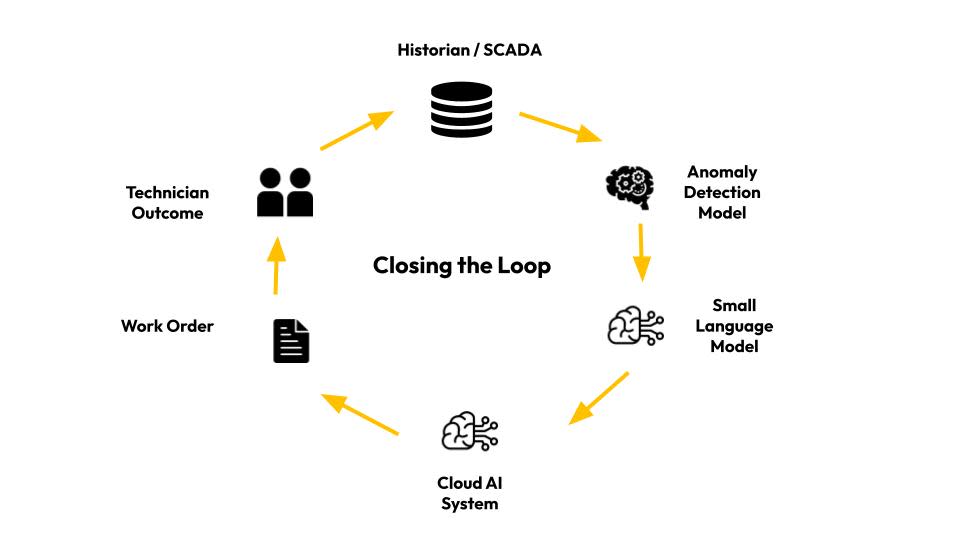
This requires feedback loops between the recommendations, workflow management and final outcomes.
E.g. When a technician completes a work order, the outcome flows back into the Historian alongside the original anomaly and recommendation.
Outcomes provide labelled examples that can inform future model training and evaluation.
Edge AI - Maintenance outcomes can refine the thresholds used to decide which anomalies to escalate.
Cloud AI - Maintenance outcomes assess how reliably its confidence estimates, evidence and recommendations reflect reality.
Over time, this reduces false escalations, unnecessary interruptions and the cost of cloud-based analysis.
Any increase in automation should follow demonstrated performance, with appropriate safety controls and approval requirements retained for higher-risk actions.
Reducing Maintenance Costs and Improving Operational Performance
Advancing maturity requires AI at the edge for volume, a frontier model in the cloud for judgement, and orchestration that closes the loop from prediction to outcome.
Post-implementation benefits will depend on asset criticality, data quality, model performance, and how effectively teams integrate AI agents into existing maintenance processes. They must be validated against operational baselines.
We built a prototype solution for the above example using two Raspberry Pi devices to simulate mine lifts, with Raspberry Pi Sense HAT sensors and device code generating operational telemetry. Data is mirrored to a cloud Historian for long-term retention.
Contact V2 AI to see the solution in action and learn how we can help your organisation advance up the maintenance maturity curve. Since expanding operations into Perth and Western Australia, we have become increasingly focused on AI enablement within mining, oil & gas, and other resources organisations.